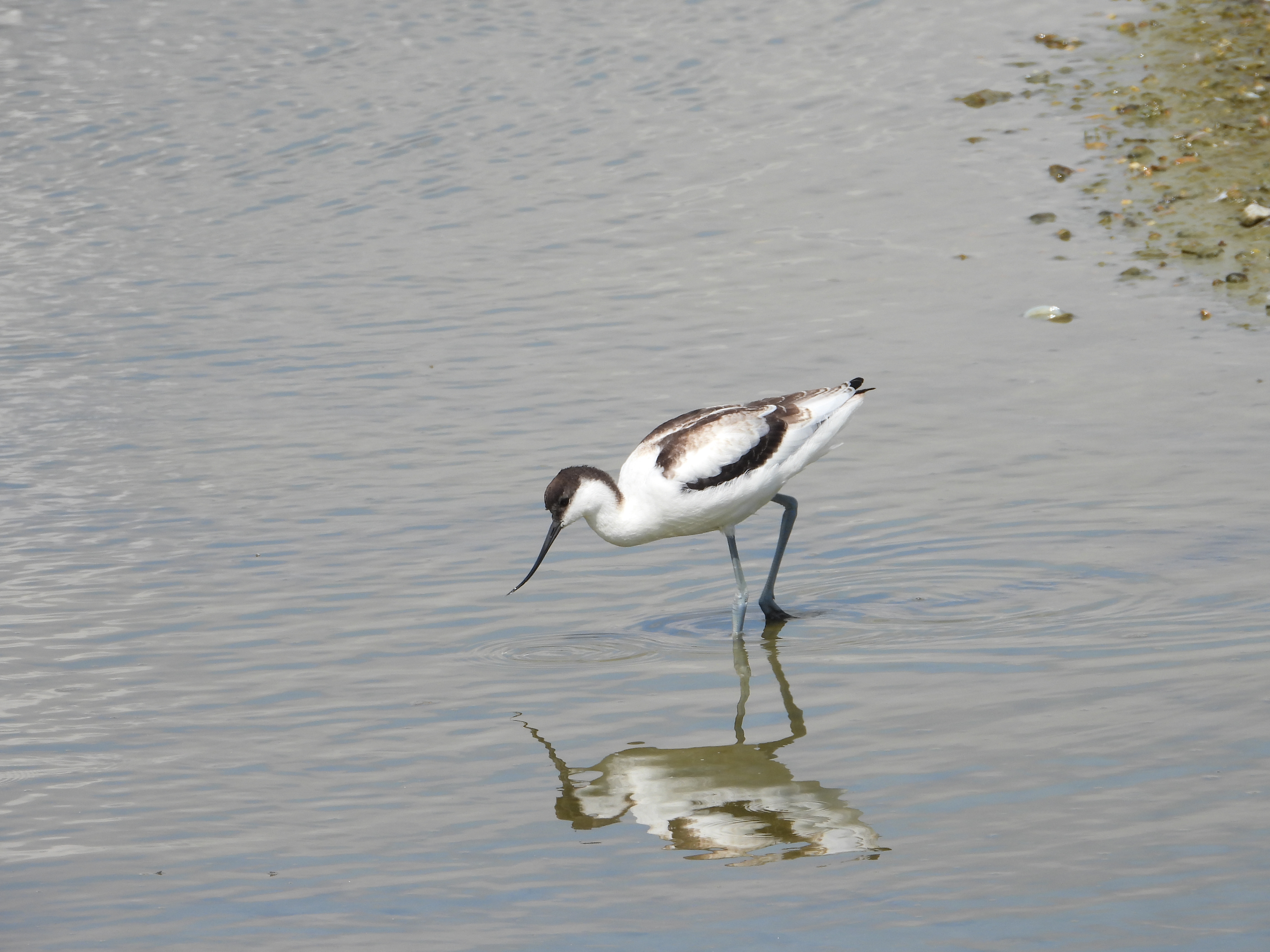
The image of an avocet above is taken from Animal Wild, one of those rather satisfying reflection shots.
The latest from the British Trust for Ornithology features an Arctic Skua on the front cover and there is much within about the success and importance of GPS tracking of tagged birds (as well as Cuckoos and others) which help us to understand more about their migratory routes and so how best we can help them.
There’s a serious and highly specific corrective reader’s letter about the speed of drumming exhibited by the Green Woodpecker – not as fast and short as previously claimed.
Climate change is affecting seabirds in particular, whether in terms of their migrations – they may “short-stop”, i.e. stay closer to their breeding grounds, because warmer conditions mean they do not need to travel so far and it is also affecting their prey (fish, sand eels) making foraging all the harder.
Events in Ukraine and Gaza have had an impact too, both being important flyways for migratory birds, such as the Greater Spotted Eagle whose journeys across Ukraine are longer and slower and where stopover sites may not be used at all.
A Woodcock survey in Britain has also revealed worrying downward population trends, the causes of which are far from entirely clear.
There is an excellent article about avian museum collections by Ken Norris of the Natural History Museum who explains their value and importance. As is the BTO mantra, we need as much scientific information as possible to understand problems and their causes. For example, a survey in the 1960s showed a decline in bird of prey populations which turned out to be the result of thinning and therefore failing eggshells. That was brought about by the use of organochlorine pesticides, which we only know from comparing eggs from collections which pre-dated the use of the chemicals. Historical baselines are crucial when considering reintroductions and phenology generally and avian collections also provide key information on, for example, DNA, bill morphology, diets, taxonomy and much else.
Time and money are the major issues when it comes to digitising the huge amount of information and making it accessible to all, worldwide, but it seems that AI will now make it all happen very much faster and more efficiently: “A job that would have taken several person-years to complete will soon be possible in a few hours.”
Training officer Jenny Donelan, part of all the online BTO courses I have attended, has written a very helpful piece about bird topography, specifically the arrangement of flight feathers (primary, secondary, tertial and so on), something I have never previously quite managed to get my head around.
I thought I might, for once, be able to get through the book review section without ordering something, but it was a pious hope. Mark Carwardine’s RPSB How to Photograph Garden Birds, Bloomsbury Publishing, 2023, is on its way. There is always more to learn.
Leave a Reply