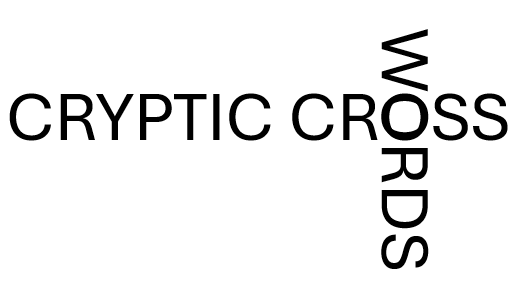

I am addicted to them. It’s a family thing – both my brother is and my parents were avid cruciverbalists. I sometimes joke that the Jumbo Cryptic in The Times on Saturdays is the highlight of my week. I do get very excited about it. It was The Independent I turned to for a long time (with some of those certain squares had to be shaded in after completion to reveal an image), but now it’s The Guardian that has me totally hooked. The cryptics there are a little freer, a little more indulgent of slang and popular culture. One of my recent favourites was A warren circled by bears and bull, OMG (5,10), which with the help of many of the crossers (letters filled in already from other answers) eventually led me to “Totes amazeballs”.
It’s the thirty or so little epiphanies every day I think. I often do more than one – I have gone all the way back to April 2023 in The Guardian so far. They are available online and this allows for letter checks and reveals as well as whole word reveals if one is really stuck, but I try not to use them. Of course there are sometimes words I have never heard of, but they can often be deduced from the clueing and then looked up to find out what they mean.
There are many types of clue. Some are just bad but amusing puns. Best of all for me are those where the ‘instructions’ for the answer are contained in the answer itself, part of which indicates an anagram of the rest. For example, one I wrote myself: Clue for, initially, good and bad, curate’s egg (5,3), giving “Mixed bag”.
Then there are the setters, anonymous in The Times but not in The Guardian. They mostly have various pseudonyms for different publications. They all have their own styles and quirks, some one gets on with better than others – it is easier to get on `some wavelengths. They shouldn’t be too easy though, that’s no fun. Occasionally I will stare at an empty grid and think I will never get started until the first answer falls into place, then another, then I’m on a roll until an elusive few remain. The setter’s aim is to mislead, by leading you up the wrong path by capitalisation or punctuation, say. They should usually be ignored. A clue might overall lead you to suppose the wrong meaning of a word. “Flower” can mean a river, but the clue might otherwise suggest a gardening answer.
There can be themes of extraordinary ingenuity (such as those by Boatman of The Guardian – I have two books of his fiendish puzzles where almost all of the clues and answers will relate to the theme in a witty, even impish variety of ways). They can be helpful of course, or not even noticed until the end, or even afterwards.
There are only so many varieties of 15 x 15 workable grids – some are much friendlier than others.
Setters are expected to be fair and to follow certain rules and there should only ever be one, unambiguous possible solution – if you’ve got it, you know for sure you’ve got it. The great compiler Ximenes was the most purist:
“A good cryptic clue contains three elements:
- a precise definition
- a fair subsidiary indication
- nothing else”
I enjoy codewords too, but they are much quicker and less challenging.
One recent answer I loved but of which I had never heard was “Mondegreen”. It is another joy of crosswords that new words will lead you into fascinating territory. “Mondegreen” is the mishearing of song lyrics or a poem and derives from an article in Harper’s Magazine by Sylvia Wright in 1954:
Ye Highlands and ye Lowlands,
Oh, where hae ye been?
They hae slain the Earl Amurray,
And Lady Mondegreen.
The correct version of the last two lines is:
“They hae slain the Earl o’ Moray / And laid him on the green.”
The other joys of the online Guardian puzzles are the comments below the grid. The first solvers are usually in Australia – they get a head start. It is a delightful world of its own with its own terminology.
Clues have “surfaces”, misleading overall meanings, and “indicators”. Clues are to be “parsed”, there are “containers” and “charades”. Sometimes the answer is actually right there in the clue, split between two or more words, which are my most common “tea tray moments” – obvious once you see it, so hit yourself over the head with a tea tray. A “nina” is a message or theme hidden in the grid but not explicitly mentioned in the clues. Furthermore, if a few clues remain unparsed, the website Fifteen Squared, or 225, carries full explanations and more comments. People say such things as “Started NE corner easily enough, but SW stumped me”, “Too much UK GK [General Knowledge] needed for this one” and other abbreviations such as NHO, “Never Heard Of” and COTD, “Clue of the Day”. “Struggled and gave up”, “Lots of checks but no reveals”, “It made me laugh” and “Hated it” are common remarks. Some puzzles are described as “write-ins”, suggesting they are too straightforward, but even those can be pretty satisfying. People, quite rightly, get very angry about “spoilers” in the comments underneath the grid and pretty angry about clues which they feel are unfair, and occasionally with each other, but mostly it is a world of friendly good humour and self-deprecation.
The Times Jumbo today was a good one, although it did contain an example of ambiguity – one answer could have as legitimately been grand niece as great niece, only the crossers narrowed it down. One clue and answer I cannot parse at all. I had to check that “doris” is a sea creature and “norn” a language. I especially liked “Manx cat” to give “panthe” as part of the answer. Two old favourites are HIJKLMNO to give “water” and Two girls, one on each knee giving “patella” which formed part of the title of Alan Connor’s excellent book on the subject, Two Girls, One on Each Knee: The Puzzling, Playful World of the Crossword, Penguin 2014.
Leave a Reply