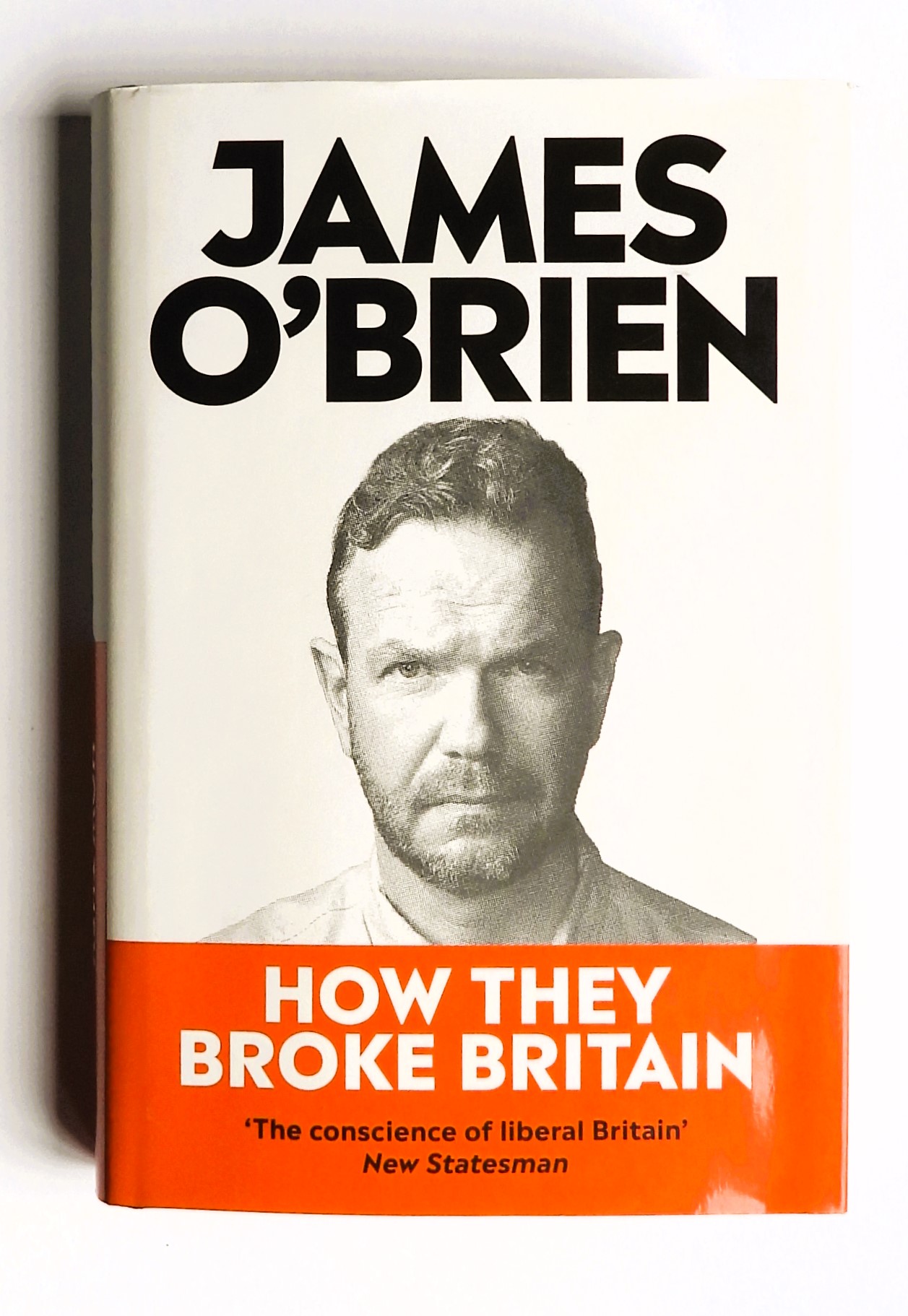
How they Broke Britain by James O’Brien, WH Allen, 2023
As one would expect if you have heard or seen the author’s radio broadcasts, this is an angry, deeply incisive, passionate and incendiary book.
There are two things it cries out for, so let me get those out of the way. The first is a glossary of acronyms – there are an awful lot of them. Not O’Brien’s fault of course, it’s the nature of the beast, but it does get confusing at times and a way of quickly referencing them would be useful. Secondly, there is no index which seems an odd omission for a book of this nature.
The second of these sent me on a tangential byway. I wondered if indexing was something or is something already that could be handled by AI. The answer is no, at least for now. Indexing software is available but it can never replace the necessary human touch. I am not sure how it would work anyway. Software might be able to pick up all instances of a certain name, say, but how would it determine when an author came to the end of writing about him? Clarkson (Jeremy), 144, 167 is not the same or as useful as Clarkson (Jeremy) 144-6, 167-9. This post from the Society of Indexers goes into this in thought-provoking detail.
Indexing and AI (indexers.org.uk)
It was not long as I rootled around the internet before I came across and ordered Index, A History of the, by Dennis Duncan, Allen Lane, 2021. The brilliance of the title alone was enough for me and it looks to be so up my street it’s ridiculous. More on this in another post at some point.
My only other niggle with O’Brien’s book so far, and it really is only a niggle, is one misuse perhaps of the word ‘egregious’ (he uses it a lot, but why not, it’s a great word?) I am a descriptive rather than prescriptive grammarian in general, but with this there is a real risk of not conveying what you actually mean. I happen to remember from a bit of banter with a fellow book cataloguer that the word comes from the Latin ex grege, out or away from the herd (grex) or crowd. So, it’s a qualifier, it does not necessarily mean outstandingly (good or) bad, although I am clearly rather out of date, online etymological dictionaries suggesting that it began to take on a disapproving tone in the sixteenth century. It’s rather like “spiralled” which I have noticed being used more and more to mean ‘spiral downwards’, but things can spiral up too so again, meaning is unclear.
The book opens with a quotation from the profoundly wise Noam Chomsky: “As long as the general population is passive, apathetic, diverted to consumerism or hatred of the vulnerable [my italics], then the powerful can do as they please, and those who survive will be left to contemplate the outcome.”
The first three chapters deal with the media titans Rupert Murdoch, Paul Dacre and Andrew Neil, and how each has used their supposedly impartial platforms to promote their right-wing agendas. As with others in the book, the issue of migration features prominently. It suits those in power, of course, to demonise outsiders and minorities and non-existent enemies and to have us fear them but feel that those in power and they alone will protect us. It is all very 1984. As the author reminds us, it is not illegal to seek asylum, although one would hardly believe so from the many, many, screamingly racist headlines we have been fed.
I have to say I saw Tony Bliar (sic) coming before many did. An article in The Guardian in 2017 by Michael White deconstructs his friendship with Murdoch. Bliar became the leader of the Labour party in 1994 and prime minister in 1997. The red flag for me was his visit in 1995 to Murdoch’s annual ‘power-fest’ as White describes it, held on Hayman Island off Queensland. There can surely be no doubt that reportage from Murdoch’s media empire helped Bliar win the election in 1997.
O’Brien has a happy knack of the withering put-down and the sometimes almost throwaway, dismissive, summary disapprobation. For example, Boris Johnson “the notorious liar”, Murdoch’s “malevolent genius” and Donald Trump “the convicted sex offender”. The second of these led me to another article in The Guardian by David Smith in 2023, headlined “Trump is now a legally defined sexual predator – will it affect his 2024 bid?” I remember thinking that when his comment about pussy-grabbing was exposed, that would be the end of him – it was by no stretch the worst thing he had done, but it would surely mean the immediate loss of the female half of the American electorate, but as Smith points out, the most shocking is how unshockable Americans have become. How normalised these things have become. Perhaps even more worryingly, he continues: “So it is that, despite two impeachments and a criminal indictment, Trump led Joe Biden by seven points in a Washington Post-ABC News poll published on Sunday. Amazingly, 18% of respondents who think Trump should be arrested still preferred him to the current president.”
A recurrent idea in the book is exemplified by a description of Ronald Reagan’s presidency during which attempts were made to “convince the public that problems are not problems [but] that the people who call attention to them are problems”. One only has to think of the way in which so many so-called ‘whistle-blowers’ have been treated in this country.
Piers Morgan, meanwhile, is described simply as “a grubby opportunist” and we are reminded that amongst all of the racist, anti-immigration rhetoric trumpeted by media and state, egregious (!) was Jeremy Clarkson’s writing about Meghan Markle. He loathed her, he said, “on a cellular level”. But that was not enough: “[I have been] grinding my teeth and dreaming of the day when she is made to parade naked through the streets of every town in Britain while the crowds chant ‘Shame!’ and throw lumps of excrement at her.” Whatever one might think about the actions and behaviour of Harry and Meghan – personally I simply don’t care very much – there is no doubt in my mind that she was subjected to appalling racism by the British media. Eammon Holmes famously described her as “uppity”, a trigger-word if ever there was one, which has tended to be used historically and stereotypically in direct association with the n-word. As the father of mixed race children, I didn’t particularly object to the question about what colour their children would be – we wondered, aloud, the same thing about our children before they were born (there are three of them and they each have a subtly different skin colour), but as so often with such things it is all about tone and intent. Which is not to say that ignorance is an excuse for racist remarks, but at least ignorance is potentially fixable.
O’Brien really excels himself when it comes to Suella Braverman: “she has repeatedly shown herself willing to go further and faster down the dirtiest of political sewers than any of her colleagues.”
The fourth chapter nominally concerns itself with the less well-known figure of Matthew Elliott, chief executive of Vote Leave, the official Brexit campaign group. This is a dense and relentless chapter (I have used the device myself, being deliberately relentless to emphasise the relentlessness of certain political machinations) and it is not the easiest of reads, but O’Brien, with his usual forensic precision, disentangles the complex web of government, campaign groups, businesses and their lobbyists, think tanks and the media and their concerted and successful efforts simply to lie to the public to achieve the result they wanted. This is not some lunatic dystopian interpretation. These are cold, hard facts.
The barbaric and utterly inhumane plan to send immigrants to Rwanda remains in place. Some idiot in my local pub was saying recently and very firmly that Britain is now full. Sometimes I take these people on, sometimes I am sorry to say I simply don’t have the energy. What I thought of asking was “At what point did it become full? Are you saying there is room only for x people, everything was fine until then, population at x-1, but then one more refugee arrived which meant the country was at that exact moment officially full?”
Incredibly and with no apparent sense of irony, the government warned just a few days ago of an impending shortage of hundreds of thousands of workers in the UK, most of all in the catering and hotel industries, with the health sector coming at number two, education at number seven.
Nigel Farage is up next – but he deserves a post all of his own.
How they Broke Britain by James O’Brien, WH Allen, 2023
.
Leave a Reply