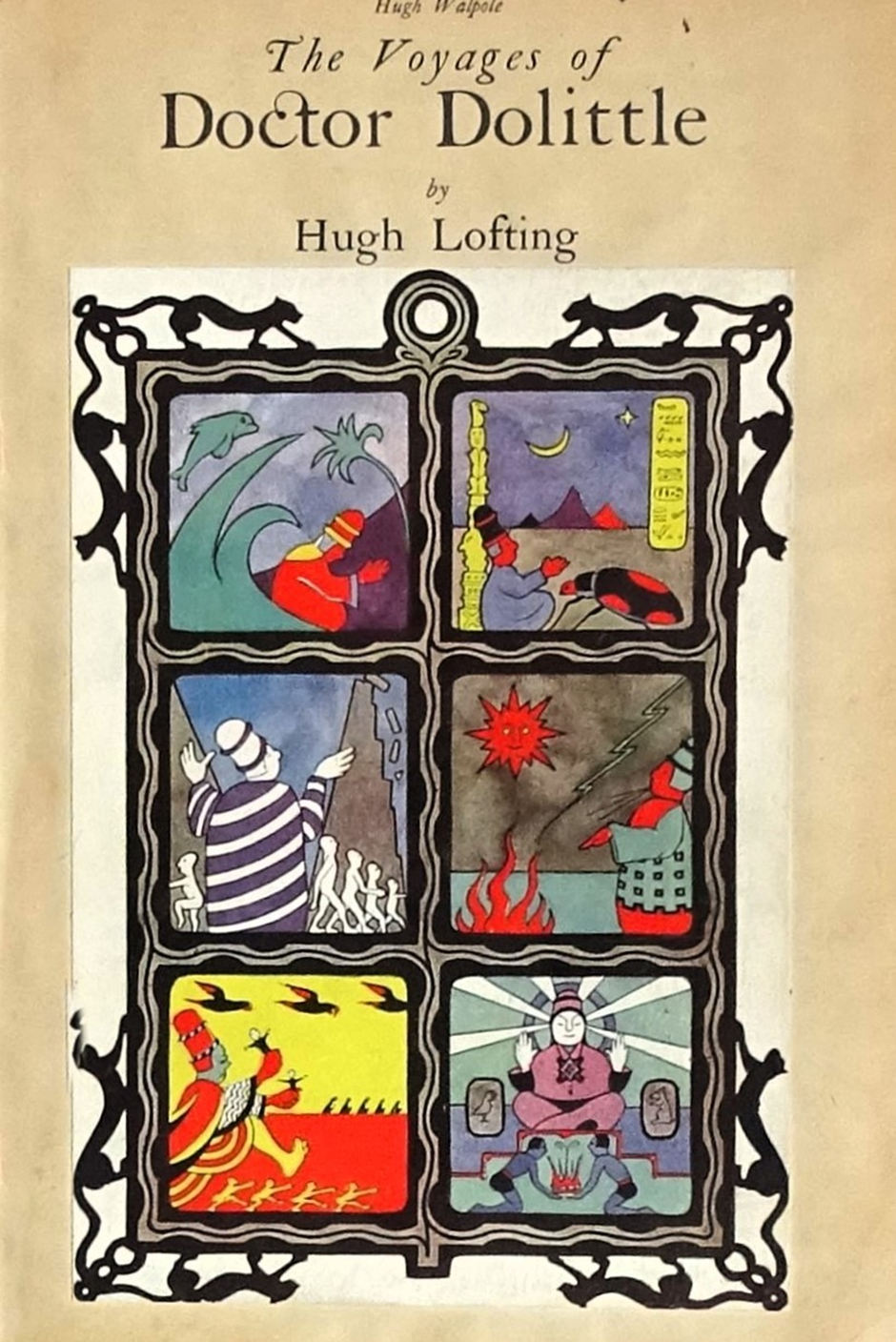
These are two extracts from Animal Trust.
“Hugh Lofting’s Dr Dolittle books were important. I have a lovely set of first English editions in delightful, colourful dust-wrappers. It was only on re-reading them decades later that I realised what a profound impact they had had. It wasn’t the good doctor’s ability to talk to animals so much as the author’s humanity and recurring arguments for treating animals with compassion and, to an extent, as equals. When a new edition was published by Red Fox in 1991, there needed to be some re-writing to remove or alter characters and incidents which were not considered racist then, but certainly are now. In an afterword, the author’s son Christopher writes about the dilemma. Is it ok to tamper with or censor the classics? Or should children be denied the opportunity of reading the books at all because of a few unintendedly offensive references? Christopher Lofting continues: “After much soul-searching the consensus was that changes should be made. The deciding factor was the strong belief that the author himself would have immediately approved of making these alterations. Hugh Lofting would have been appalled at the suggestion that any part of his work would give offence and would have been the first to make the changes himself … The message that Hugh Lofting conveyed throughout his work was one of respect for life and the rights of all who share the common destiny of our world. That theme permeates the entire Doctor Dolittle series.”


“There’s a fondly remembered passage from Hugh Lofting’s The Story of Doctor Dolittle. A boy, whose uncle has been lost at sea, pulls a red handkerchief from his pocket. The eagles have already looked everywhere. But Jip the dog smells snuff:
“SNUFF, by Jingo! – Black Rappee snuff. Don’t you smell it? His uncle took snuff – Ask him, Doctor.” The Doctor questioned the boy again; and he said, “Yes. My uncle took a lot of snuff.” “Fine!” said Jip. “The man’s as good as found. ’Twill be as easy as stealing milk from a kitten. Tell the boy I’ll find his uncle for him in less than a week. Let us go upstairs and see which way the wind is blowing.” “But it is dark now,” said the Doctor. “You can’t find him in the dark!” “I don’t need any light to look for a man who smells of Black Rappee snuff,” said Jip as he climbed the stairs. “If the man had a hard smell, like string, now – or hot water, it would be different. But snuff! – Tut, tut!” “Does hot water have a smell?” asked the Doctor. “Certainly it has,” said Jip. “Hot water smells quite different from cold water. It is warm water – or ice – that has the really difficult smell. Why, I once followed a man for ten miles on a dark night by the smell of the hot water he had used to shave with – for the poor fellow had no soap…. Now then, let us see which way the wind is blowing. Wind is very important in long-distance smelling. It mustn’t be too fierce a wind – and of course it must blow the right way. A nice, steady, damp breeze is the best of all… Ha! – This wind is from the North.”
Then Jip went up to the front of the ship and smelt the wind; and he started muttering to himself, “Tar; Spanish onions; kerosene oil; wet raincoats; crushed laurel-leaves; rubber burning; lace-curtains being washed – No, my mistake, lace-curtains hanging out to dry; and foxes – hundreds of ’em – cubs; and – ” “Can you really smell all those different things in this one wind?” asked the Doctor. “Why, of course!” said Jip. “And those are only a few of the easy smells – the strong ones. Any mongrel could smell those with a cold in the head. Wait now, and I’ll tell you some of the harder scents that are coming on this wind – a few of the dainty ones.” Then the dog shut his eyes tight, poked his nose straight up in the air and sniffed hard with his mouth half-open. For a long time he said nothing. He kept as still as a stone. He hardly seemed to be breathing at all. When at last he began to speak, it sounded almost as though he were singing, sadly, in a dream. “Bricks,” he whispered, very low – “old yellow bricks, crumbling with age in a garden- wall; the sweet breath of young cows standing in a mountain-stream; the lead roof of a dove- cote – or perhaps a granary – with the mid-day sun on it; black kid gloves lying in a bureau- drawer of walnut-wood; a dusty road with a horses’ drinking-trough beneath the sycamores; little mushrooms bursting through the rotting leaves; and – and – and – ” ”
Leave a Reply